The Palace Theatre at Cambridge Circus: a history and seat guide
Carte's red-brick opera house of 1891 has outlasted failure, bombs and neon, and its long runs are the stuff of legend.
By Only Soho Editorial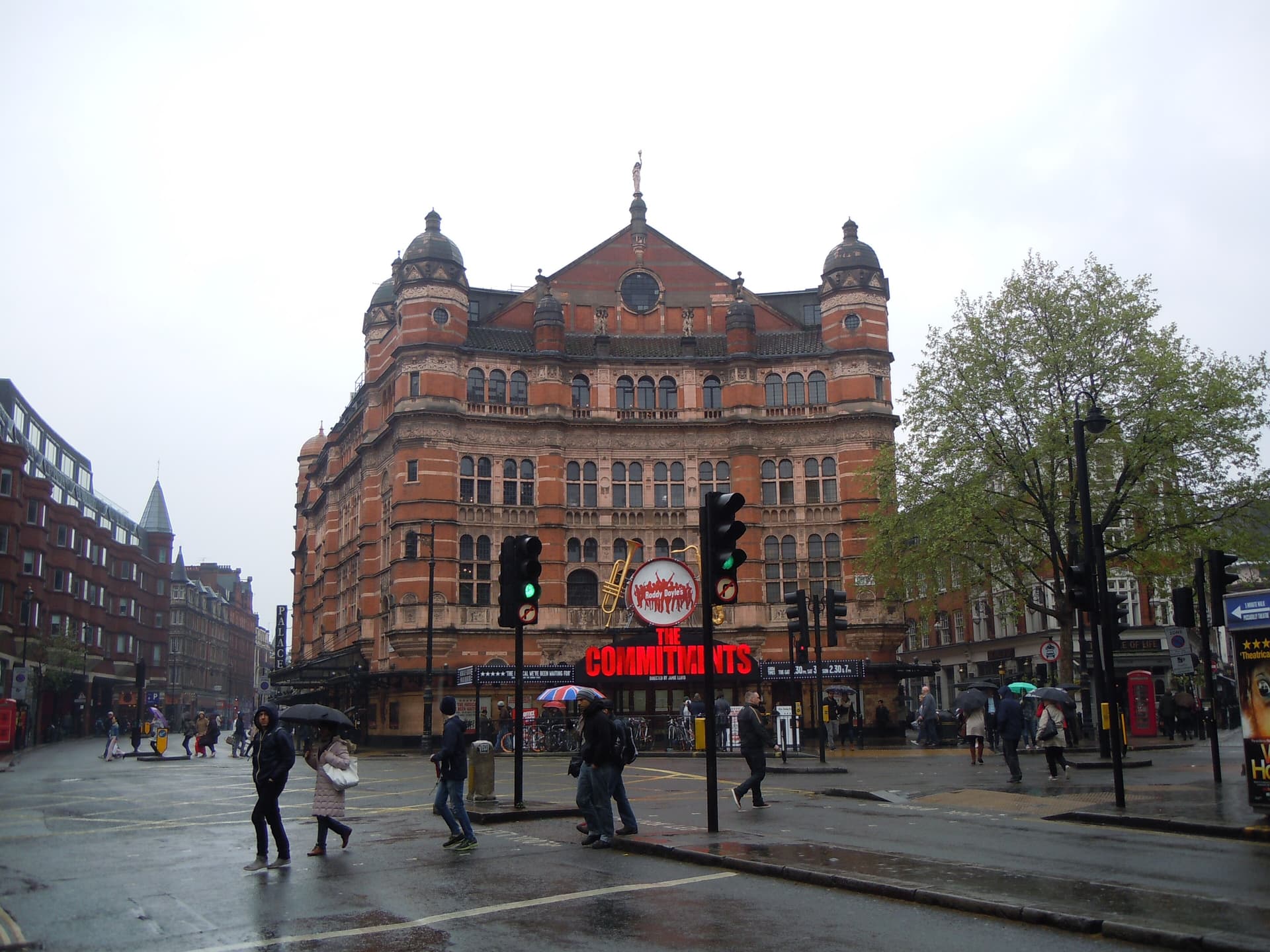
The red-brick bulk of the Palace Theatre stands on an island site at the end of Shaftesbury Avenue, and it dominates the view at Cambridge Circus, the corner where Soho meets Theatreland. It is Grade II* listed, seats about 1,400, and has lived several lives: opera house, music hall, home of the longest runs. Here is the story, and how to sit well.
Carte's opera house, 1891
Richard D'Oyly Carte, the impresario who brought Gilbert and Sullivan together, built it as the Royal English Opera House. The architect was Thomas Edward Collcutt, working with G. H. Holloway, with James George Buckle as associate architect and theatre consultant. Carte's wife Helen laid the foundation stone in 1888, and it can still be seen on the façade, almost at ground level to the right of the entrance. Go and look before the doors open.
The building was novel for its day, with upper levels carried on heavy steel cantilevers (so says Wikipedia). It opened on 31 January 1891 with Arthur Sullivan's grand opera Ivanhoe, which ran for roughly 155 to 160 performances. Then the trouble: André Messager's La Basoche followed briefly, and Carte had nothing else ready to fill the house. He leased it to Sarah Bernhardt for a season of French drama in 1892, then sold it at a loss within a year.
Music hall, war and the long runs
It became the Palace Theatre of Varieties, managed first by Sir Augustus Harris, then Charles Morton. Film screenings began in 1897, and from 1904 Alfred Butt mixed variety with films. The Russian dancers Anna Pavlova and Michael Mordkin appeared here, and a 1910 postcard in the Theatres Trust collection shows the advertisement.
Like many London theatres it closed during both World Wars, and it took severe bomb damage in the second. A revival of Chu Chin Chow ran in 1940 and 1941, and in 1957 The Entertainer, starring Laurence Olivier, transferred from the Royal Court.
Then came the marathons:
- The Sound of Music: its London stage premiere here in 1961, running for 2,385 performances.
- Jesus Christ Superstar: 1972 to 1980, with one source giving 3,358 performances.
- Les Misérables: it opened at the Barbican on 8 October 1985, transferred to the Palace that December and stayed for 19 years, moving in April 2004 to what is now the Sondheim Theatre, on Shaftesbury Avenue at Wardour Street. Les Mis is the West End's longest-running musical, second overall only to The Mousetrap.
Later tenants included The Woman in White, Monty Python's Spamalot, Priscilla, Queen of the Desert, Singin' in the Rain and The Commitments. Since 2016 the house has belonged to Harry Potter and the Cursed Child.
Restoration and the building today
A buyer who paid £1.3 million found marble and onyx panels under a layer of paint, and later said he removed the huge neon from the front. The exterior was restored in the late 1980s, and the interior had a major restoration in 2004 after Les Mis left. The current owner is Nimax Theatres.
Look up at the façade: red brick and terracotta in an early Spanish Renaissance style, three shallow bays of tiny arched windows, and domes at each corner. Inside are plush scarlet seats, cherub sculptures at every level and a revolving stage.
Getting there
The address is Cambridge Circus, Shaftesbury Avenue, W1D 8AY. Leicester Square (Northern and Piccadilly lines) and Tottenham Court Road (Central, Northern and Elizabeth lines) are the nearest tubes, and Charing Cross is the nearest rail station. Walking times are short, around three to five minutes from either tube, though treat that as rough.
How to get good seats
Level names vary between sellers, so check the names on the official booking page. The advice below comes from ticket agents and seat reviewers, not the theatre, and the seating notes were written for the older two-part show, so the set and rig may differ.
- Best bets: London Theatre Direct points to the stalls or royal circle. Headout recommends central stalls, rows B to K, and the front of the dress circle. Another guide likes stalls rows G to K, because the stage is elevated.
- Value: the back of each section, such as the centre of the upper balcony or the grand circle at the rear. A mid-balcony centre seat is a sensible bargain, though it is high and steeply stepped.
- Be wary: the back stalls under the circle overhang (rows S to V in the official plan), balcony rows A to D with handrails in the sightline, and seat D29, behind a pillar. Dress circle legroom can be tight, and one guide advises against the very front rows because of the curve of the section.
- Accessibility: wheelchair spaces are in the stalls, and aisle seats suit anyone wishing to transfer from a wheelchair.
Prices vary by date. Tickets for the one-part show have been listed from about £25 to £37 at the cheaper end. Book through the official site where you can.
Order of the day: stalls centre, a few rows back from the stage, and a minute spent at the foundation stone on the way in. Sources: Wikipedia, Arthur Lloyd, Cinema Treasures and London Theatre Direct.