When Mozart lived on Frith Street
A boy of eight, a watchful father and a house on Frith Street that is long gone. Here is where it stood and what happened inside.
By Only Soho Editorial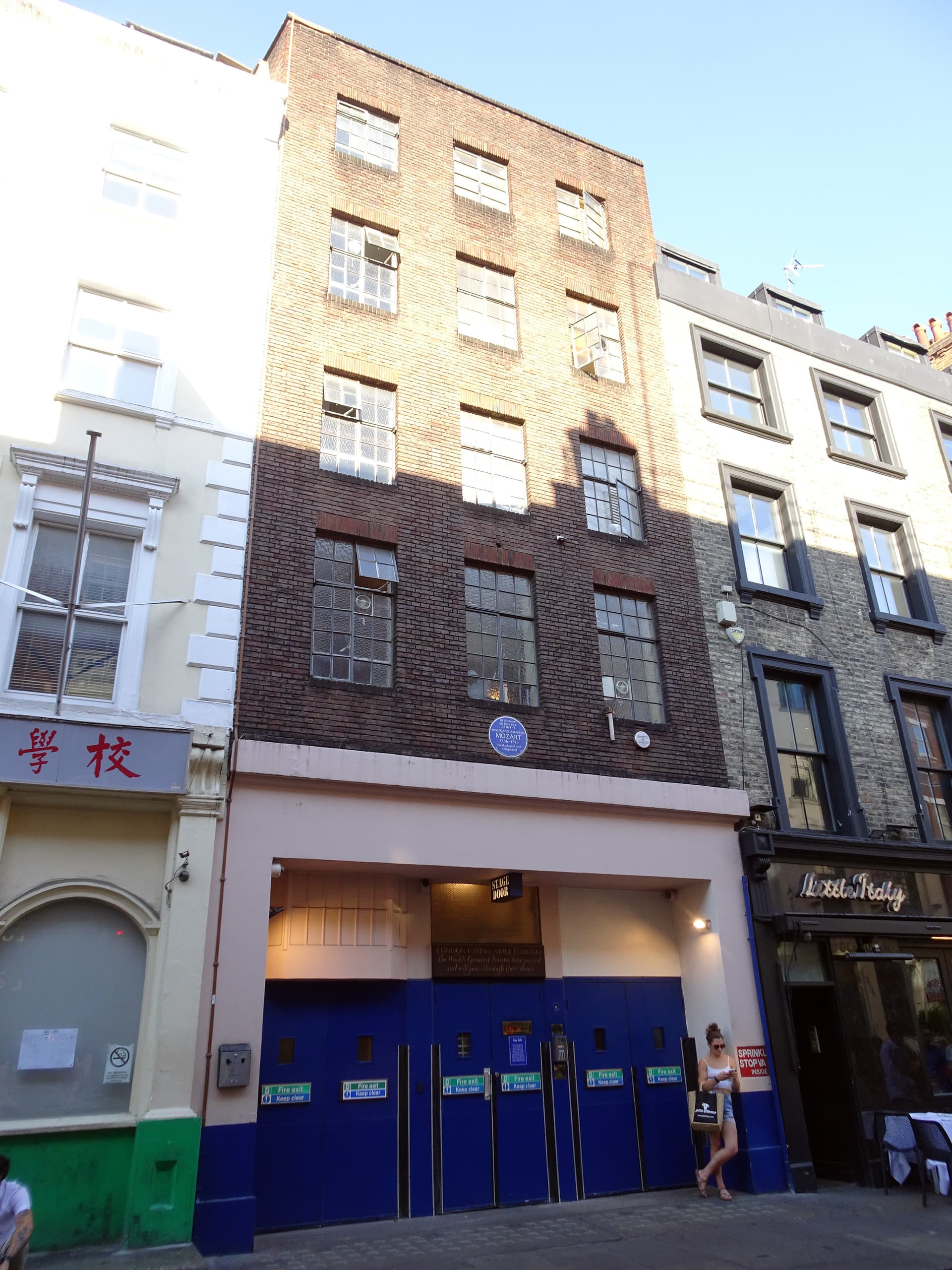
The pavement outside 20 Frith Street gives nothing away. There is a stage door, a plaque above it and, a few steps along, the corner of Old Compton Street. This is where the eight-year-old Wolfgang Amadeus Mozart lodged with his family in 1764 and 1765. Go on a weekday morning when the street is quiet and you can read the plaque properly.
Where the house stood
The Mozart house stood on the east side of Frith Street, close to Old Compton Street. The site is now numbered 20. The building you see was put up in 1858 by William Cooze, and it replaced a house of about 1725. Mozart lodged in the earlier one, so there is no room to stand in. There is only the spot.
In the 1760s the street was written "Thrift Street" and the house was No. 15. The number changed after 1773, when Monmouth House, whose grounds ran from Soho Square down to Queen Street (now Bateman Street), was pulled down and new houses were built on its land. Wikipedia's entry on 20 Frith Street sets out the renumbering.
Since 1930 the building has been the stage door of the Prince Edward Theatre, which fronts Old Compton Street. Beetlejuice The Musical is the current production. For the plaque, simply stand on the pavement and look up.
The plaque, and a small catch
The plaque looks like an English Heritage blue plaque, but it is not one. According to mylondonwalks it was put up in 1991 by the Royal Musical Association. As reported by Alamy, it reads: "In this house in 1764-5 Wolfgang Amadeus Mozart, 1756-1791, lived played and composed."
English Heritage judged 20 Frith Street unsuitable for its own scheme because of substantial rebuilding. Its official Mozart plaque went up at 180 Ebury Street in 1939. That is where the family stayed in Chelsea before Soho, and where the first symphony, K16, was composed in the late summer of 1764. So the first symphony belongs to Chelsea. English Heritage tells the Ebury Street story.
Three addresses in 15 months
The Mozarts reached London on 23 April 1764 and left for the Continent on 24 July 1765. It was the longest the family stayed anywhere on a tour that ran from July 1763 to November 1766. Wolfgang was eight on arrival, his sister Nannerl was 13, and their father Leopold directed everything.
- First came Cecil Court, off St Martin's Lane, above a barber's.
- Then Five Fields Row, now 180 Ebury Street, from 6 August 1764, a move made to help Leopold recover from a chill.
- Then Thrift Street, Soho, from about the end of September 1764.
The Grub Street Project explains why Soho made sense: Leopold wanted the base that was best for business. The area had many immigrant artists and craftsmen, including Huguenots, and several foreign-born musicians lived nearby, such as the harpsichord maker Burkat Shudi.
What happened in the house
Mozart dedicated his Opus 3 sonatas (K.10 to 15) to Queen Charlotte from this address, in January 1765 according to Survey of London. The engraved title page says they were sold at the author's lodging in Thrift Street, Soho. Survey of London also lists a run of early works probably composed in Frith Street, so the house was a working room, not just a bed.
It was a shopfront too. Spring 1765 adverts invited ladies and gentlemen to hear the children at home in the afternoon. Tickets for the concert of 13 May 1765 were to be had from Mr Mozart at the lodging in Thrift Street, at five shillings. Survey of London's Frith Street entry is the fullest account.
It was also in London that Mozart met Johann Christian Bach, youngest son of J.S. Bach. English Heritage says this happened while he was at Frith Street, and that Bach shaped his style. In June 1765 Leopold let Wolfgang be examined at the house by Daines Barrington, a lawyer, antiquary and Fellow of the Royal Society. His report appeared in Philosophical Transactions in 1770 as "Account of a very remarkable young Musician", one of the two earliest printed accounts of Mozart in English.
The concerts
The family appeared at court three times, starting on 27 April 1764 at Buckingham House for George III and Queen Charlotte, within five days of arriving. They received 24 guineas.
- 5 June 1764: the public debut at the Great Room, Spring Garden, near St James's Park. About 200 people attended.
- Late June 1764: a charity concert at Ranelagh, Chelsea, where Wolfgang played a concerto on the organ.
- 21 February 1765: the Little Theatre in the Haymarket, with overtures billed as the work of the "astonishing" children.
- 13 May 1765: the last public concert, at Hickford's Great Room in Brewer Street, Soho, billed as for the benefit of Miss Mozart of Thirteen and Master Mozart of Eight Years of Age, "Prodigies of Nature". Prices were reduced, as the novelty had worn off.
The Brewer Street room had moved there in 1739 and measured 50 by 30 feet. It is a short stroll from Frith Street, and worth a detour as the only Soho concert hall on the list. Before leaving, the children appeared daily for a week in July 1765 at the Swan and Hoop Tavern.
Make a stop of it
Frith Street keeps its musical habit. At 47 Frith Street is Ronnie Scott's, which opened in 1959 and moved to Frith Street in 1965. Classic FM describes the Mozart house as very close to a building of "enormous musical heritage". Late evening is the time for it: the club is open until three in the morning on Mondays and from Wednesday to Saturday. Take a seat for the late set, after seeing the plaque in daylight.
Read the plaque first, then Classic FM's account of the London years, and Frith Street starts to look rather different.