Meard Street and the Georgian houses of Soho
A narrow street off Dean Street holds some of the finest early Georgian houses in London. Here is what to look at, and where to go next.
By Only Soho Editorial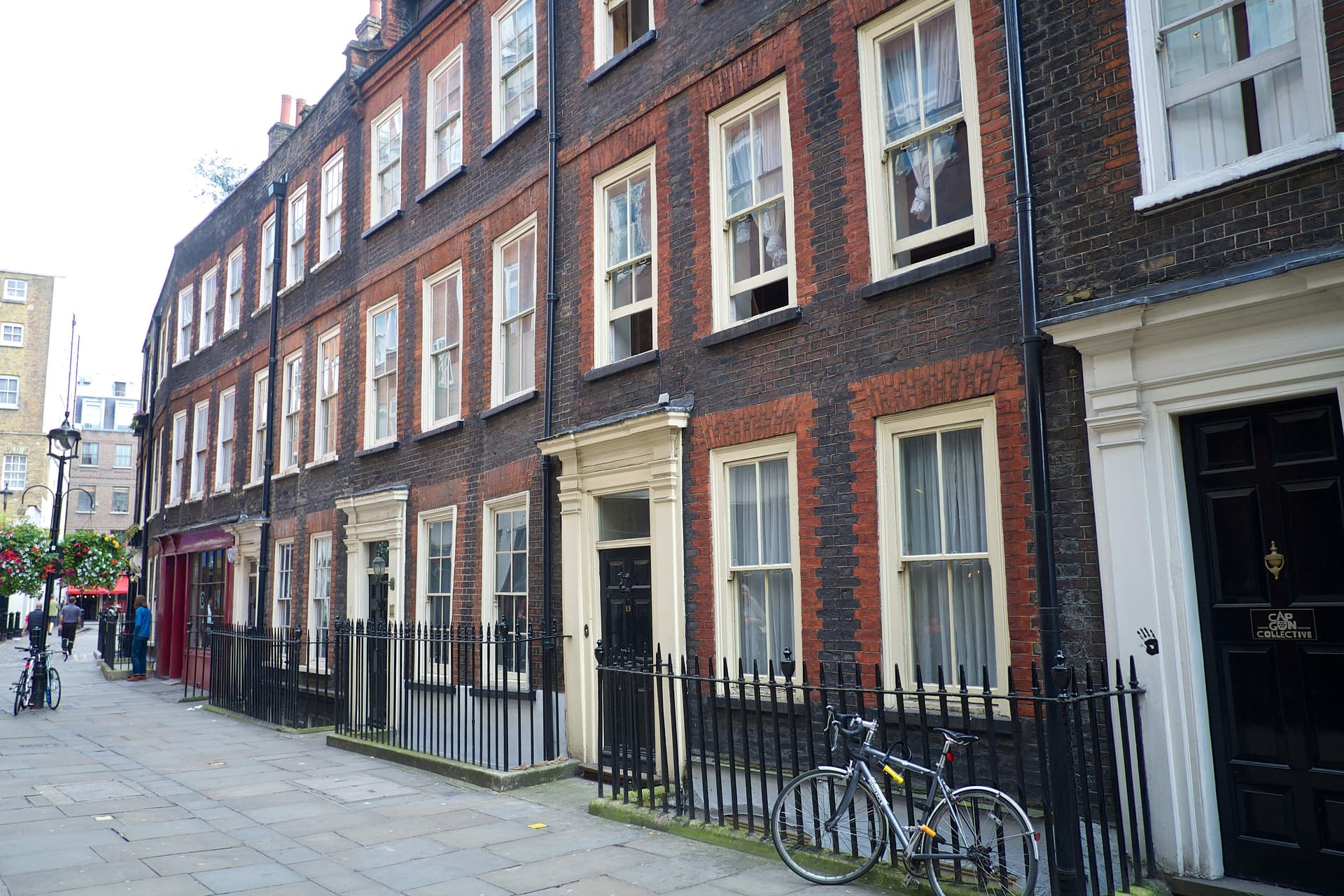
Meard Street is the quickest way to feel Soho before it was Soho as we know it. It runs between Wardour Street and Dean Street, in two halves with a slight bend: the west half is pedestrianised, the east half a narrow single-lane road. The houses are private homes, so this is a street to look at from the pavement, not to knock on.
Who built it, and when
The street takes its name from John Meard the younger, a carpenter who later styled himself esquire, and who developed it in the 1720s and 1730s. The plaque on the Dean Street corner says the street was built between 1720 and 1732 and is one of the few surviving streets in London from the early 18th century. It adds that most of London's Georgian houses date from the late 18th or early 19th centuries, which is what makes this terrace so unusual.
The Survey of London explains the patchwork. Only the eastern, wider end was built on the Pitt estate, Nos 1 to 7 (odd) and 2 to 6 (even), with leases dated March 1731/2. The western part sits on the Pulteney estate, where Meard's leases for Nos 8 to 20 (even) date from March 1722/3. He built the east end in 1732, at the same time as 67 to 70 Dean Street. The Survey calls the almost complete, little-altered south side the best group of early Georgian houses surviving in the parish.
Soho House's history page says Meard rose to Master of the Worshipful Company of Carpenters in 1735 and worked with Sir Christopher Wren at St Paul's. Historic England is more careful: it says only that he was possibly the same Meard. Treat the Wren link as a maybe.
What to look at on the façades
Historic England lists Nos 1 to 7 (odd) at Grade II*, describing them as uniform terrace houses of about 1732 by John Meard. Take your time over these details:
- The brickwork: brown stock brick with red-brick dressings and a stuccoed ground floor, under a slate roof.
- The proportions: four storeys plus basement, each front three windows wide. Nos 9 and 11 are a narrower pair, three storeys with dormered mansards.
- The doorways: wooden architrave doorcases with boldly carved consoles holding up hoods. On Nos 3 and 5 the doors are paired, while Nos 1 and 7 have theirs to the left and right.
- The fanlights: rectangular and simple. Historic England notes fanlights arrived from about the 1720s to let light into the hall.
- The parapets: the Building Act of 1707 required roofs to be hidden behind an 18-inch parapet with a brick or stone cornice, a fire-safety rule.
- The ironwork: wrought-iron area railings with urn finials.
Nearly all of Meard's houses are still standing and listed Grade II*, according to Historic England, which counts the street among the best places in London to experience early Georgian architecture. Other Grade II* groups are Nos 2 to 6 and 13 to 21. One small oddity: No. 9 has a mid-19th-century shopfront inserted into its ground floor.
Go in the morning or early evening, when the street is quiet and the light rakes across the brick. The narrow east end is the best spot to stand and look back along the terrace.
Then walk Dean Street
Historic England runs a free self-guided Spotter's Guide to the early Georgian townhouse, with eight stops: Meard Street, 67 and 68 Dean Street, 69 and 70, 33 and 33a, 76, 78, 88 and 90 Dean Street. It is aimed at novices, and it tells you something useful at each door. Look for the pediments on top of the architraves at No. 77, and at 90 Dean Street for the raised ground floor and semi-circular fanlight, which show how fashions shifted.
The guide also explains the piano nobile: the first floor was the main entertaining floor, until by the end of the 18th century entertaining moved down to the ground floor.
Dean Street Townhouse, 69 to 71 Dean Street
Numbers 69 and 70 are a pair of Georgian houses built by Meard, now home to Dean Street Townhouse, run by Soho House. This is the one place on the route where you can sit down inside Meard's work without being a member. Afternoon tea is served in the parlour, Monday to Saturday, 2 to 5pm, at £32 a head, or £46 with a glass of Thienot Champagne. Time Out's 2026 afternoon tea list ranks it tenth and calls it one of the best-value options in town. Book ahead through OpenTable. Order the afternoon tea and take a seat in the parlour.
76 Dean Street
Soho House's club at 76 Dean Street joined the Georgian block in 1732 and keeps its Georgian fireplaces and an original mural on the staircase. It is members only, so enjoy it from the pavement as a stop on the Historic England route.
A few other Georgian addresses
The Survey of London says Nos 26 to 28 Dean Street, where Quo Vadis stands, were erected around 1734 under building leases granted to the carpenter John Nolloth. Karl Marx lodged with his family in two small rooms at No. 28 from 1851 to 1856. Quo Vadis itself dates from 1926 and was founded by Peppino Leoni.
On Frith Street, Hazlitt's at No. 6 is made up of historic Georgian houses, dating back to 1718 according to Wikipedia. The essayist William Hazlitt died there in 1830, and a plaque marks it by the front door.
Not everything that looks Georgian is. The Jane Austen's London site notes that Georgian and Victorian frontages in the area often hide 17th-century houses, and Soho's first streets, Frith Street and Greek Street among them, were going up from 1680. Greek Street has several 18th-century and earlier houses but looks mostly 19th-century.
Start at the Dean Street corner plaque, walk the length of Meard Street, then return along Dean Street with the Historic England guide in hand. Finish with the £32 tea at number 69.
Sources: Survey of London, London Remembers, Historic England and OpenTable.